Bulding a Competition Platform
I co-run SUPAXXL, a parkour community based in London. What started as a local competition format evolved into a platform designed to let any community run their own competition. This is about how we got there.
supatakeover.co.ukThe Problem
Most community events don't scale beyond the people who run them. They're tied to a single location, a specific moment in time. Hard to replicate and hard to hand off to anyone else.
How do you create something that any community can run, not just attend?
That question shaped everything. Not "how do we make a better event" but "how do we make a system that works without us."
Yard Takeover: Testing the System
We started locally. Yard Takeover was a month-long competition format built for the London parkour community, running out of Yard in Greenwich.
The format centred on roughly 200 challenges spread across the month. Participants submitted short video clips, scored and fed into a leaderboard called the Takeover League. The system was designed to sustain engagement over weeks, not just a single day. Challenges frequent enough to keep people coming back, with public submissions so progress was visible to the whole community.
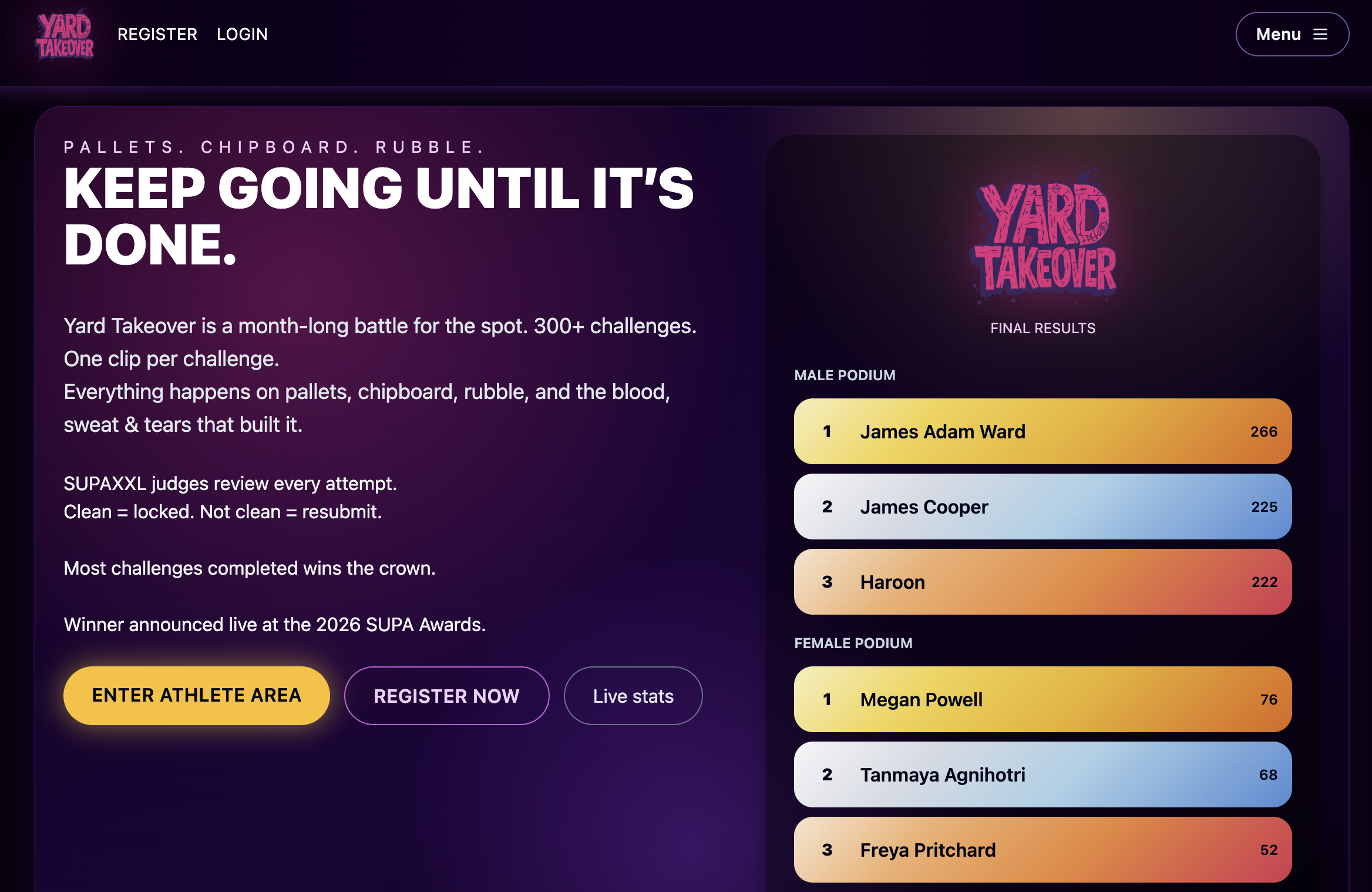
It worked. Engagement held across the full month. People who weren't regulars started showing up. We had something we could learn from.
Designing for Behaviour
A lot of the system design was about influencing behaviour without making it feel engineered. Public submissions gave people visibility, Leaderboards created progression and Cash prizes & sponsor rewards gave people a reason to push harder.
We also identified a gap in participation: women were underrepresented in competition formats like this. Introducing equal prize pools was one of the most direct ways to address it, and it worked, but making sure that there was no disparity and all athletes were seen as equal on the platform was key.
- Sustained engagement across an entire month
- Participation extended beyond the core community
- Produced a repeatable system we could build on
From System to Platform: Supa Takeover
Once we'd proven the model locally, the next step was making it portable. Supa Takeover takes those same core mechanics and turns them into something any organiser can run in their own city. The submission format and scoring were already proven. The harder problem was making everything simple enough that someone in a different city could pick it up without us in the room.
The platform isn't tightly controlled. It gives communities enough structure to run something consistent while leaving room for them to make it their own.
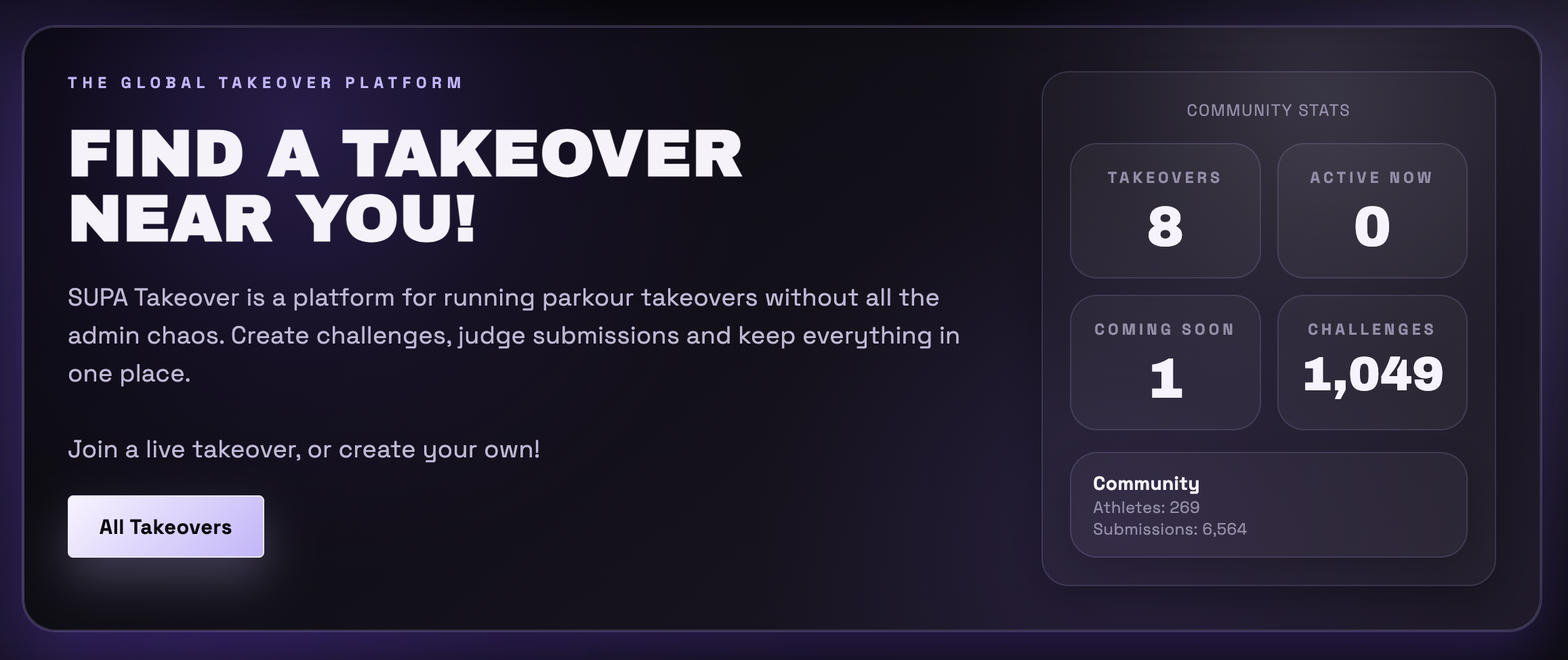
- Created the foundation for the platform to grow beyond London
- Shifted the model from a single event to something replicable
- Enabled community-led expansion without centralised control
The user testing of this tool has been through the roof and the amount of bugs that have been discovered that i've never had to worry about has been astronomical. How do i address video upload and storage? How do i set admin controls for people that aren't me! how do i make it so i don't need to be on hand to help someone set it up
This tool has already made a huge dent to the competition scene in Parkour, especially in Scotland where they're now holding entire leagues across the country using the platform. (Also something that is baked into the tool)
Another great thing that this project has brought, is the cross collaboration across countries too. There is a project has allowed me to connect with another maker who is creating a spot map (parkour.spot) which is now fully integrated into the platform to help comp creators pick spots.
We also set up an API for parkour.spot to integrate our platform into their map, so if a competition is happening, it gets shared on their platform!
Yard - the foundation stone
Yard in Greenwich shaped the identity of everything we built. Raw and urban. We deliberately avoided the kind of polished event branding that would feel out of place there. The visual identity leaned into gritty textures and minimal production, with references that felt authentic to the community rather than designed to explain it to outsiders.
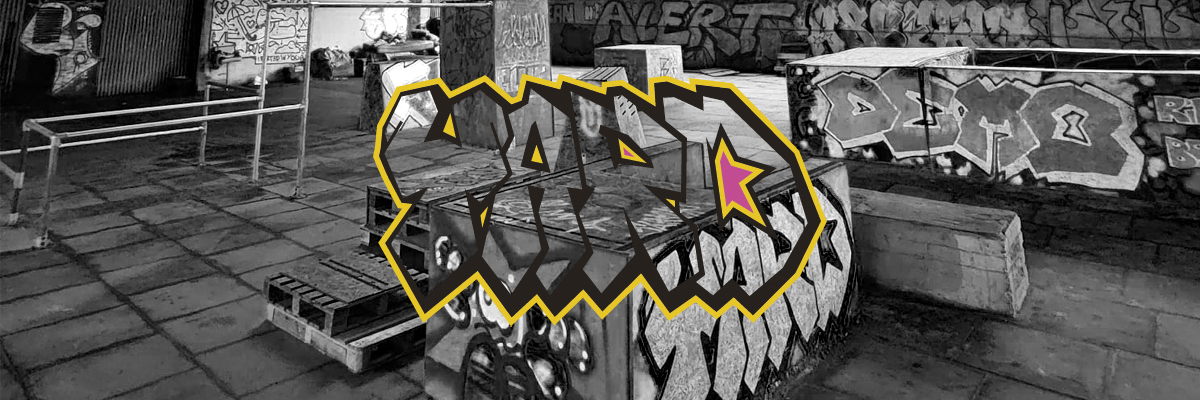
That identity became part of what makes the format recognisable. It also travels. The same aesthetic works in other cities because it's grounded in something real rather than built for mass appeal.
- Strong cultural identity rooted in the environment
- High recognition within the community
- Visual identity that travels without losing authenticity
London Massive
Yard Takeover built towards a final live event: London Massive. It was the physical payoff for a month of online participation. A full day with speed competitions, tricks-for-prizes, open jam sessions, and sponsor involvement.
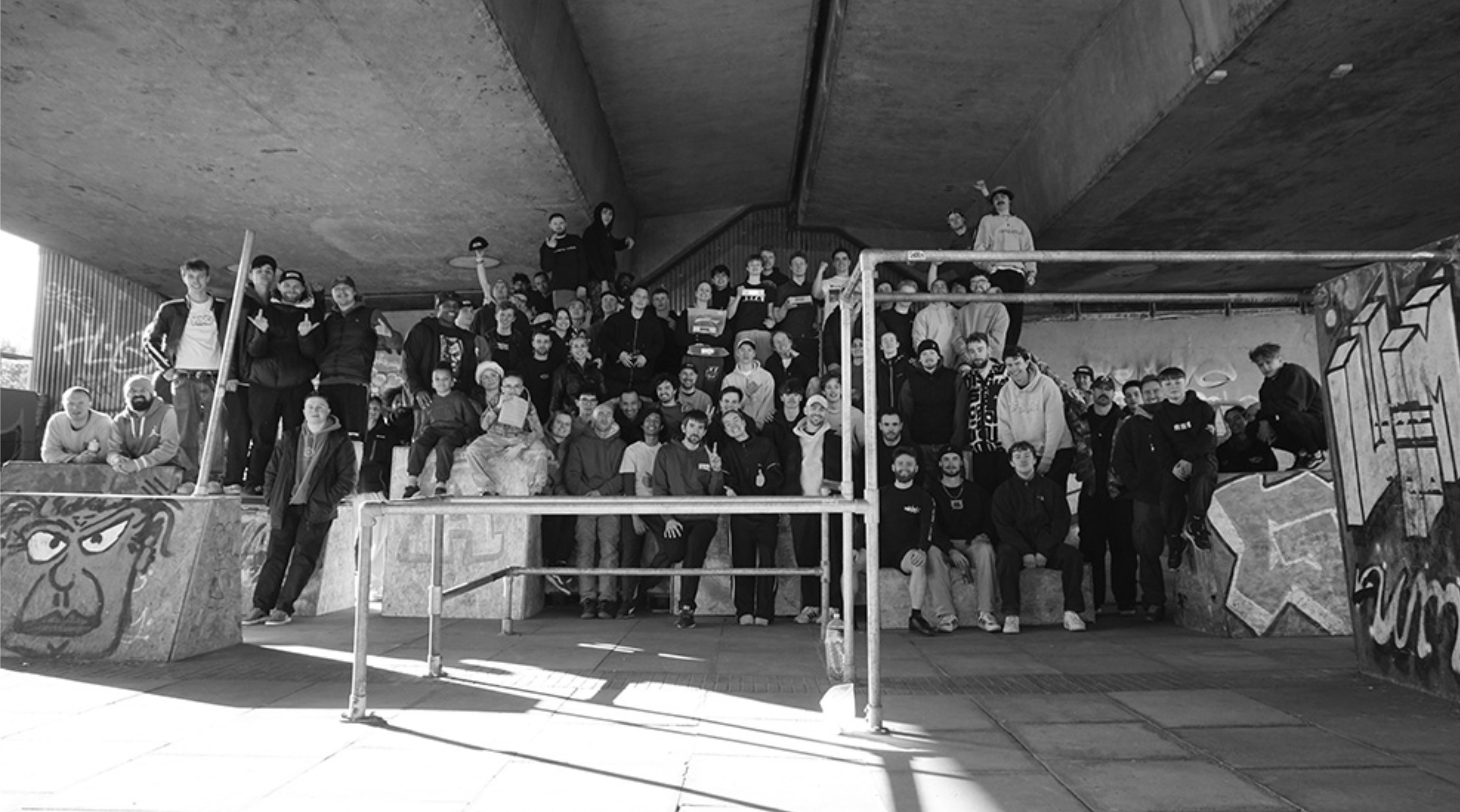
Around 100 people came. A large proportion of them had been taking part throughout the month, which meant the event felt like a community arriving rather than a crowd assembling.
- ~100 attendees at the culmination event
- Strong overlap between month-long participants and live audience
- Reinforced SUPAXXL as the hub for the London parkour community
The Bigger Shift
Not all systems live in software. Some live in communities.
My Role
- Co-run SUPAXXL and help shape its direction
- Designed the Yard Takeover competition system from scratch
- Defined rules, mechanics, and participation model
- Helped evolve the concept into the Supa Takeover platform
- Led brand, tone of voice, and creative direction
- Managed digital touchpoints and community engagement
What I'd Do Next
- Keep expanding the SupaTakeover platform
- Develop clearer onboarding for new cities
- Create a data layer to track participation and engagement across events
- Expand inclusion initiatives beyond prize pools