Finding a use for old tech
A printer with no driver. A Kindle in a drawer. A TV full of ads. Prompt & Solder helps people find real projects built with Claude, check what happened and decide what to try.
Visit Prompt & SolderWhat could you do with it?
I wanted to see how people were using Claude to repair and repurpose tech. My first request mentioned missing printer drivers, jailbroken Kindles and removing TV ads. I wanted a place where someone could find those examples and understand how they worked.
What’s live · 6 November 2026
- 1,748 builds with explanations and links back to the original sources.
- 25 topics covering hardware repairs, rebuilt software and other experiments.
- A public Claude connector so people can search the collection from their own account.
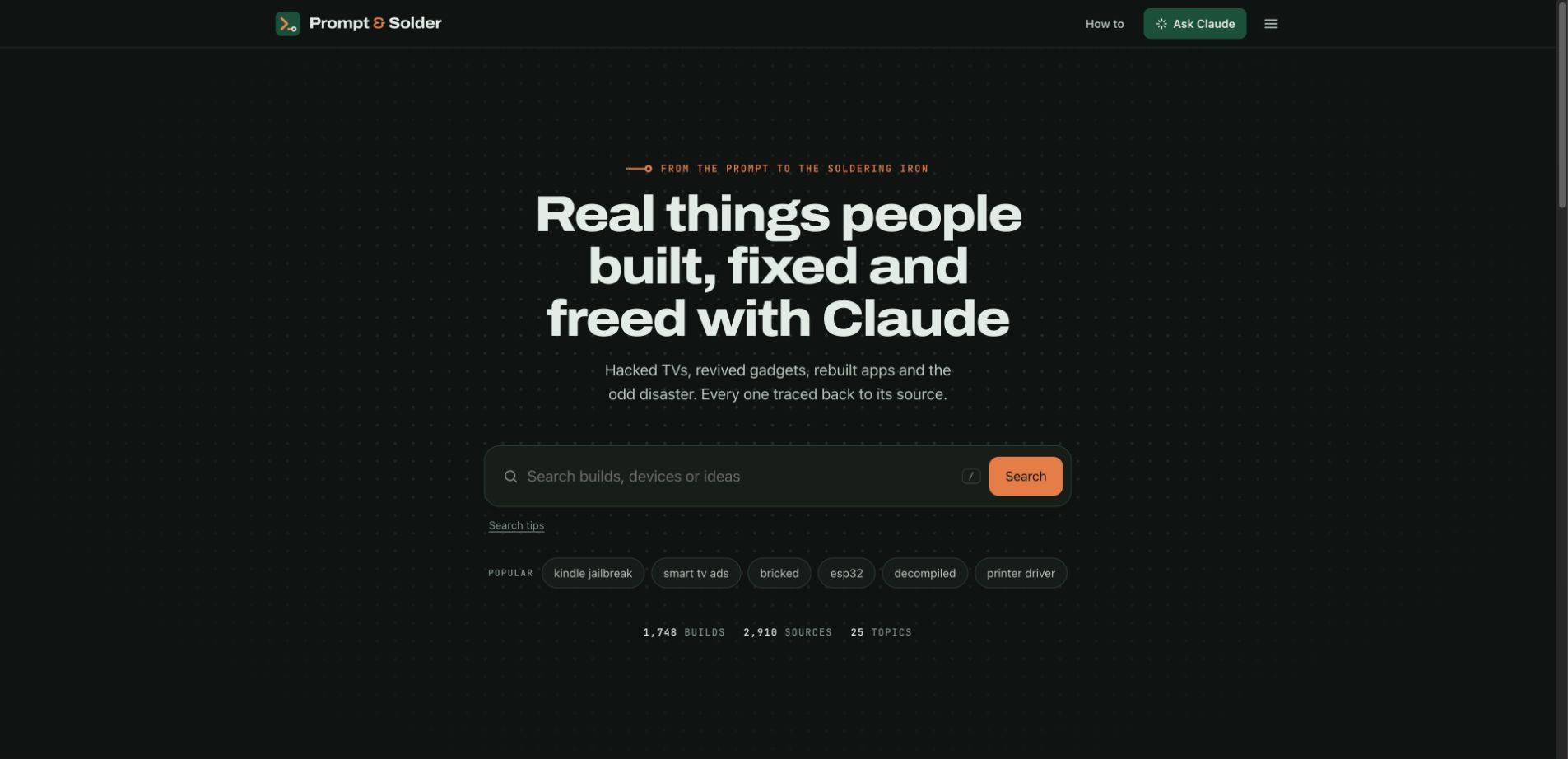
The idea
Start with a device or a problem. Find someone who has tried something similar, then read what they did.
The difficulty
A promising post is not enough. People need to know which device it applies to, what actually worked and how much evidence there is.
I want to be 100% transparent about where it's all coming from.
My request for the sources page, 6 November 2026
Make the evidence visible
- Link every build to its original sources.
- Credit creators where the source supports it.
- Record compatibility and requirements when known.
Keep the uncertainty visible
- Separate documented builds from passing claims.
- Do not assume a link’s poster made the project.
- Leave unknown details blank.
Start with “kindle”, not a project name
I made search the main way in, with example queries, topics and filters to help people narrow the collection. Results have their own shareable pages. Each build explains what happened and gives people the sources to check.
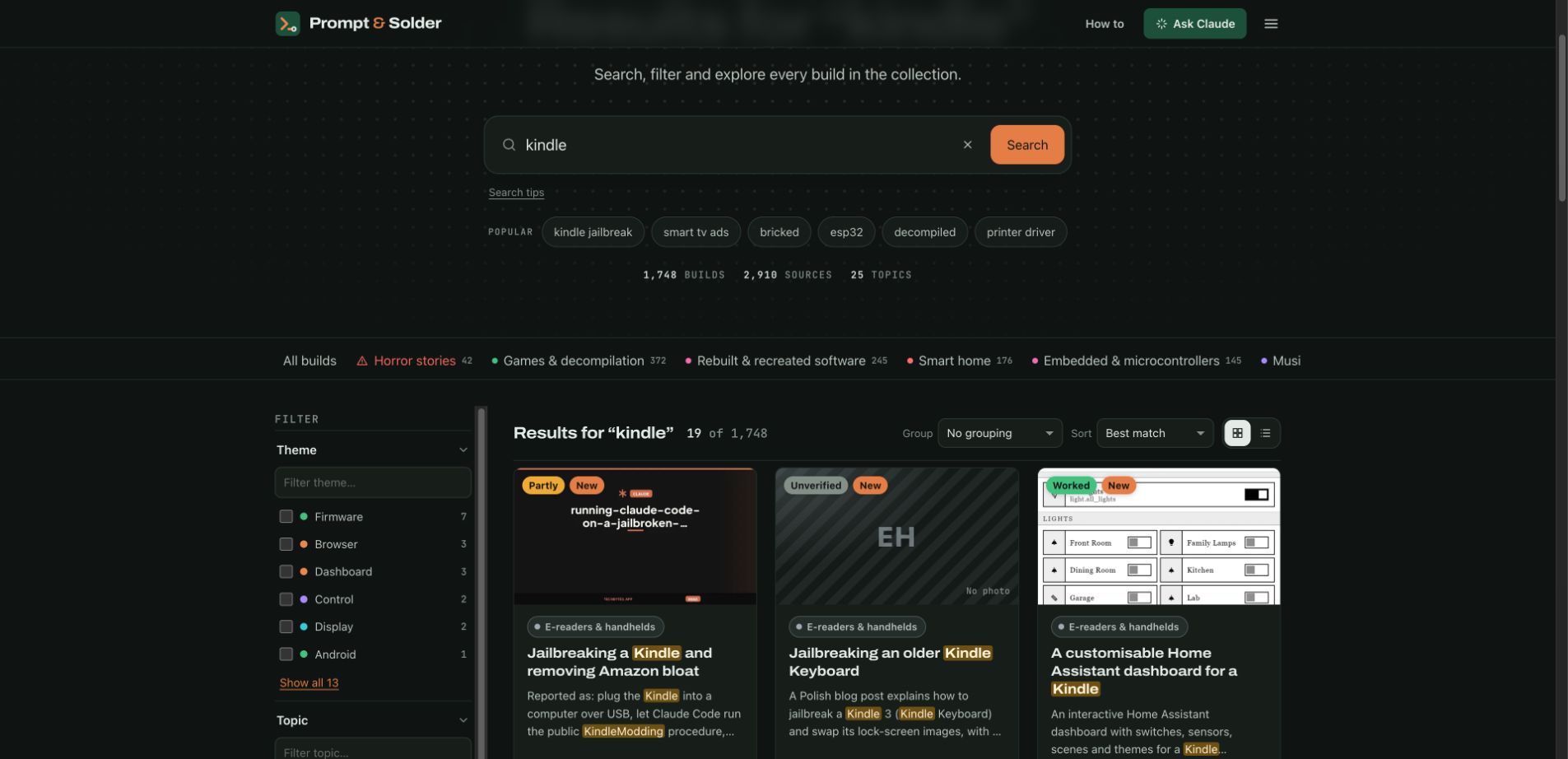
The failures belonged in it too
I specifically asked for horror stories. If someone tried to improve a device and bricked it, or an agent deleted their files, that was worth finding before trying the same thing.
What that changed
- Outcomes stay visible. Worked, partly worked, failed and unverified builds are distinguished.
- The lesson stays with the build. Where the source supports it, the page explains the risk and whether a change can be reversed.
Same question. Very different answers.
On my account
The first Ask Claude version used an artifact. I could describe a problem and get a detailed answer using examples from the collection.
On my friend’s account
The same question produced a much weaker response. The artifact was falling back to keyword matches rather than giving him the connected conversation I intended.
I can't afford to provide credits for other people
The constraint I raised during the build, 6 November 2026
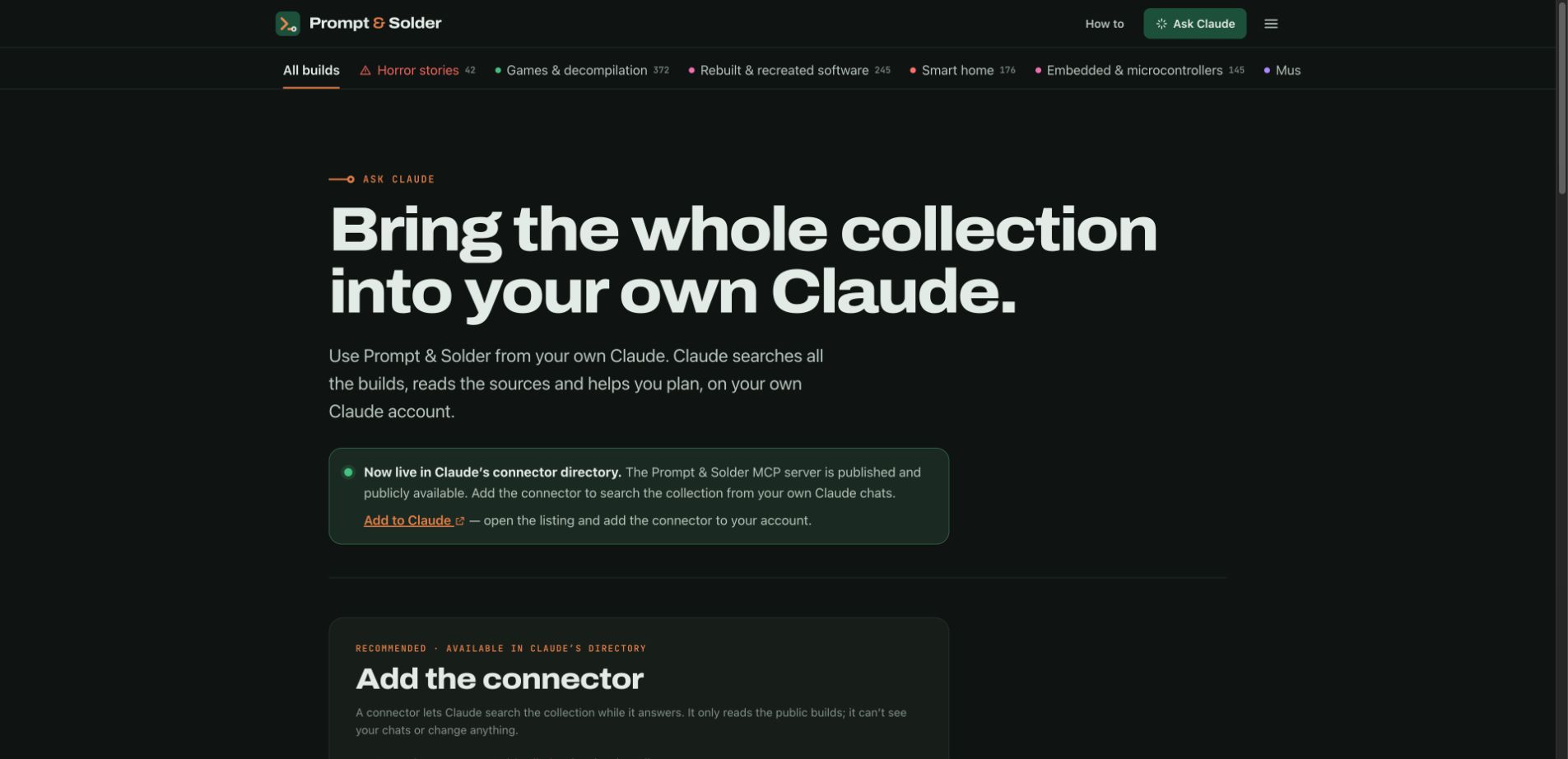
Let people bring their own Claude
I replaced the artifact with a public, read-only MCP connector. Claude can search the collection and retrieve build details from the visitor’s own chat.
A companion skill explains how to check relevance, cite the sources and keep documented projects separate from Claude’s suggestions. People can now add the connector from Claude’s directory.
Then I asked why it was slow
A mobile audit scored 52 and transferred roughly 12.5 MiB. Large images and the catalogue were doing too much work. Responsive thumbnails, compressed data and search preparation away from the interface thread made a measurable difference.
Measured changes
- 12.5 MiB → 1.7 MiB transferred in the optimisation audit.
- 600 ms → 70 ms of main-thread blocking in those lab runs.
- 52 → 82 for the mobile performance score. A later loading-order pass scored 80.
These are individual lab runs, not a guarantee for every visitor. The performance notes preserve the reports and the later result.
The system behind the screens
A catalogue of 167 discovery venues gives research a structure. New finds still need review, and that count does not mean every venue has been exhaustively searched. Daily discovery, source-preservation rules and a documented handoff help keep the collection maintained across Claude and Codex.
What I owned
I set the product direction, chose the content rules and features, reviewed the interface and tested it with other people. Claude Code and Codex handled substantial research and implementation under that direction.
I did not hand-code every part. My role was to keep deciding what the product needed to do, and check whether it did it.
What I would test next
My friend’s experience changed the integration. It showed why a working session on my account was not enough.
The next question is which examples people actually use, and where they get stuck. The site is live, but I cannot yet say how many devices it has helped people repair.
Explore Prompt & Solder
Browse the projects, or search the collection from your own Claude chat.